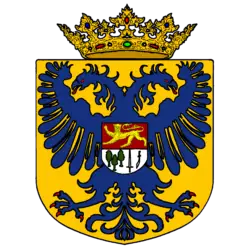
The other thread
The Habsburg-Lorraine Line
Vienna after 1740, and how the Austrian succession passed
Most people who have heard of the Habsburgs have heard of Vienna: the Hofburg, Schönbrunn, Maria Theresa, Franz Joseph, Sarajevo. That is a real and remarkable history, and it is not this family’s. This page is here because the question comes up constantly and deserves a straight answer rather than a shrug.
The answer has a shape people rarely expect. There was not one split. There were two, two hundred years apart, and they are entirely different in kind. One was a decision. The other was a death.
Two partings, two centuries apart
Two brothers agree to share an inheritance that had become too large for one man to hold and too scattered for one man to reach. Nobody dies out. Nobody is disinherited. The house simply runs on two legs instead of one, under the same name and the same arms.
The Spanish branch runs out of heirs in 1700. The Austrian branch runs out of sons in 1740. The second ending is the one that changes the name, because what comes after it descends from a Habsburg daughter and a Duke of Lorraine.
The first parting: two brothers
Charles V inherited, by a sequence of well-arranged marriages and badly-timed deaths, the Burgundian Netherlands, Spain and its new possessions across the Atlantic, large parts of Italy, the Austrian duchies, and in 1519 the imperial title on top of all of it. It was the largest accumulation in Europe since Rome, and it was ungovernable by one person travelling at the speed of a horse.
So he divided the work. At Worms in 1521 and at Brussels in 1522 he made over the Austrian hereditary lands to his younger brother Ferdinand, who had been brought up in Spain and who now went east to govern a frontier under pressure from the Ottoman advance. Ferdinand was elected King of the Romans in 1531, and acquired the claims to Bohemia and Hungary by his own marriage.
When Charles gave everything up between October 1555 and January 1556, the division became permanent: Spain, the Netherlands, Italy and the Indies to his son Philip; the Austrian lands and, in time, the imperial title to his brother Ferdinand. Two branches. One family, one name, one coat of arms, and a great deal of correspondence between them.
This was not a quarrel and it was not a break. It was an administrative answer to a map.
The second parting: an ending, twice over
Madrid, 1 November 1700. Charles II of Spain died without children, and the Spanish branch ended with him. His will left the monarchy to a French prince, and Europe spent thirteen years fighting about it. The settlements of Utrecht and Rastatt left a Bourbon on the Spanish throne and handed the Spanish Netherlands and much of Italy to Vienna.
Vienna, 20 October 1740. Charles VI died, and with him the male line of the Austrian branch. He had a brother who had died before him, two nieces, and two surviving daughters. He had no son.
These two dates are why the phrase “the Habsburgs died out” gets repeated so often. It is true of both of those branches, and it is why the eighteenth century is a hinge in any account of the name.
The Pragmatic Sanction, and an heiress
Charles VI could see it coming for twenty-seven years. On 19 April 1713 he issued the document known as the Pragmatic Sanction: the Habsburg lands were to be indivisible, and in the absence of a son they were to pass to his own daughter ahead of his brother’s daughters. He then spent the rest of his reign buying guarantees of it from every power that would sell one, usually at a price.
The guarantees were worth what such guarantees are usually worth. His daughter Maria Theresa succeeded him at twenty-three, and within two months Prussia had invaded Silesia. The War of the Austrian Succession ran until 1748, when the Peace of Aix-la-Chapelle confirmed her inheritance at last. She kept the lands. She lost Silesia, and never stopped minding.
One thing the Pragmatic Sanction could not do was make her Emperor. The imperial title was elective and no woman had ever been chosen. It went first to the Elector of Bavaria, as Charles VII, and on his death in 1745 to Maria Theresa’s husband. She was Queen of Hungary and Bohemia, Archduchess of Austria, and ruler of everything her father had left her; the title she is usually given, Empress, she held as his consort.
A duchy given up, and a name made
She had married Francis Stephen, Duke of Lorraine, in February 1736. They had known each other since she was six, and by the standards of eighteenth-century dynastic arrangement the marriage was a conspicuously happy one. It was also a diplomatic problem, because Lorraine lay on the wrong side of the French frontier and France was not prepared to watch it become an appendage of Vienna.
So the price of the marriage was the duchy. Francis Stephen surrendered Lorraine, which passed for his lifetime to the dispossessed King of Poland and thereafter to France, and received in exchange the Grand Duchy of Tuscany, which fell vacant when the last of the Medici died in 1737. The exchange was settled definitively at Vienna in 1738. He gave up the country his family had held for seven hundred years in order to marry her.
Their descendants are therefore Habsburg through their mother and Lorraine through their father, and the house has carried both names ever since: Habsburg-Lothringen, Habsbourg-Lorraine, Asburgo-Lorena.
The full name is sometimes shortened to its first half. We use both halves here. A duchy of seven hundred years is not a small thing to have given away, and the accurate name is also the better story.
[hoh_component slug=”threads”]
Where this family stands
From 1740 the name runs in two threads rather than one. The Vienna thread carries the inheritance, the palaces, the archives and the public history, under the joined name. This family’s thread runs from Charles V through his son John of Austria, and on through the Low Countries — eleven generations in which nothing happened that anybody thought worth writing down, which is very largely why it survived.
Both threads begin at the same castle above the Aare, and for five hundred years they were the same thread. That is the part worth holding on to.
The family makes no claim to any former land, domain or office. Those places belong to the people who live in them now, and we would rather say so plainly than leave it to be wondered about. What the family keeps is a name, a record of the people who carried it, and the work of keeping that record straight.
We hold the Vienna line in respect, and everything on this site about it is written in that spirit.
A note on what became of Lorraine
Stanisław Leszczyński held the duchy until his death in 1766, kept a famously civilised court at Lunéville and Nancy, and left behind one of the handsomest squares in Europe. Lorraine then passed to France, where it has remained but for the years between 1871 and 1918. Tuscany, given in exchange, stayed with the Habsburg-Lorraine family until 1859.
- Heads of the HouseThe succession this family carries, one man to each generation.
- Women of the HouseMaria Theresa at greater length, with the women who came before her.
Sources
- Martyn Rady, The Habsburgs: To Rule the World (Basic Books, 2020).
- Charles W. Ingrao, The Habsburg Monarchy 1618–1815 (Cambridge University Press, 2nd edn 2000).
- Michael Hochedlinger, Austria’s Wars of Emergence 1683–1797 (Longman, 2003).
- Die Welt der Habsburger, Schloss Schönbrunn Kultur- und Betriebsges.m.b.H., for the text and date of the Pragmatic Sanction of 19 April 1713.